Moving to Melbourne: what the data actually says
Short answer: there is no single best suburb in Melbourne for everyone moving here — it depends on whether you weight safety, value, family amenity or street life. Montmorency leads on safety, Eltham North leads on the families blend, Yallambie leads on value for money. The median suburb rents at $408/wk and its median house price is $1,295,500. Every figure below is computed from official data for all 216 suburbs, and you can re-order the ranking yourself on the Melbourne suburb map.
By Formada3D research · Updated 10 October 2026
Is moving to Melbourne a good idea? · What salary do you need to live in Melbourne? · Where should I live when moving to Melbourne? · Which Melbourne suburbs are the safest to move to? · Which Melbourne suburbs are best for families? · How much does it cost to buy a house in Melbourne? · Which Melbourne suburbs will boom? · Which Melbourne suburbs are close to the CBD and easy to commute from? · Where do young professionals live in Melbourne? · How do I compare two Melbourne suburbs before choosing?
Is moving to Melbourne a good idea?
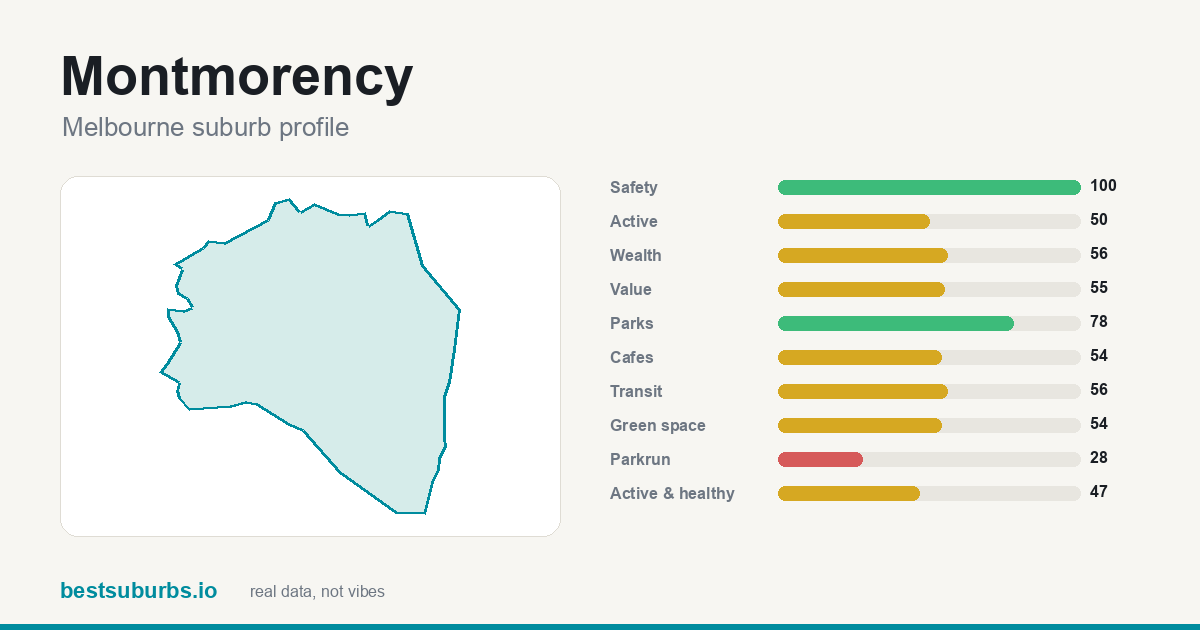
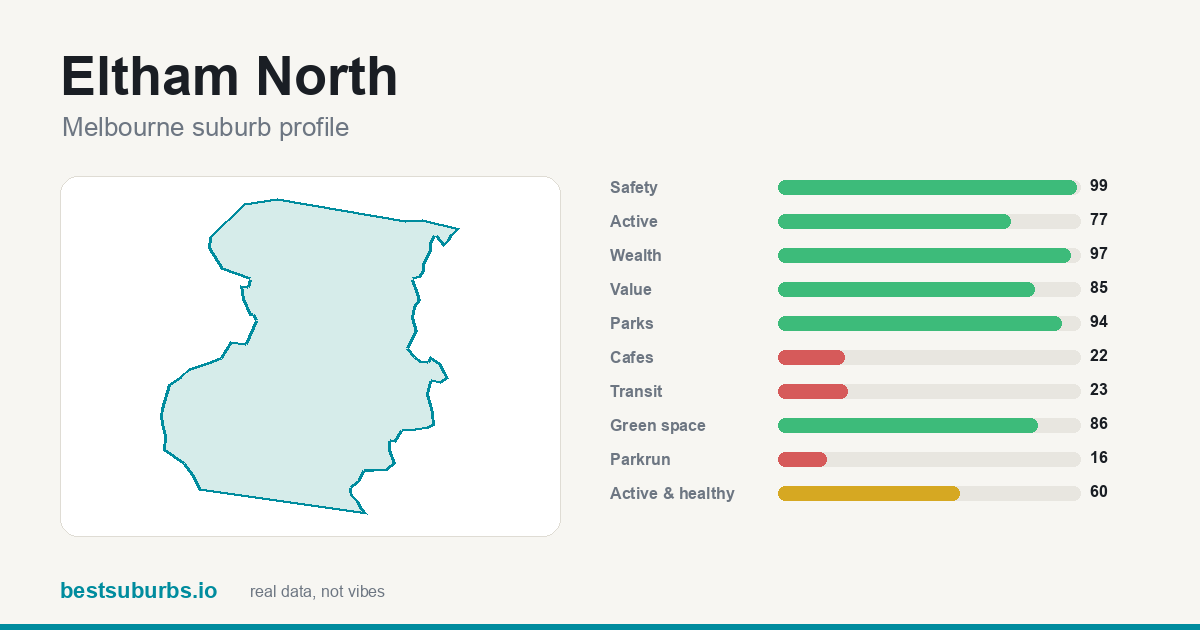
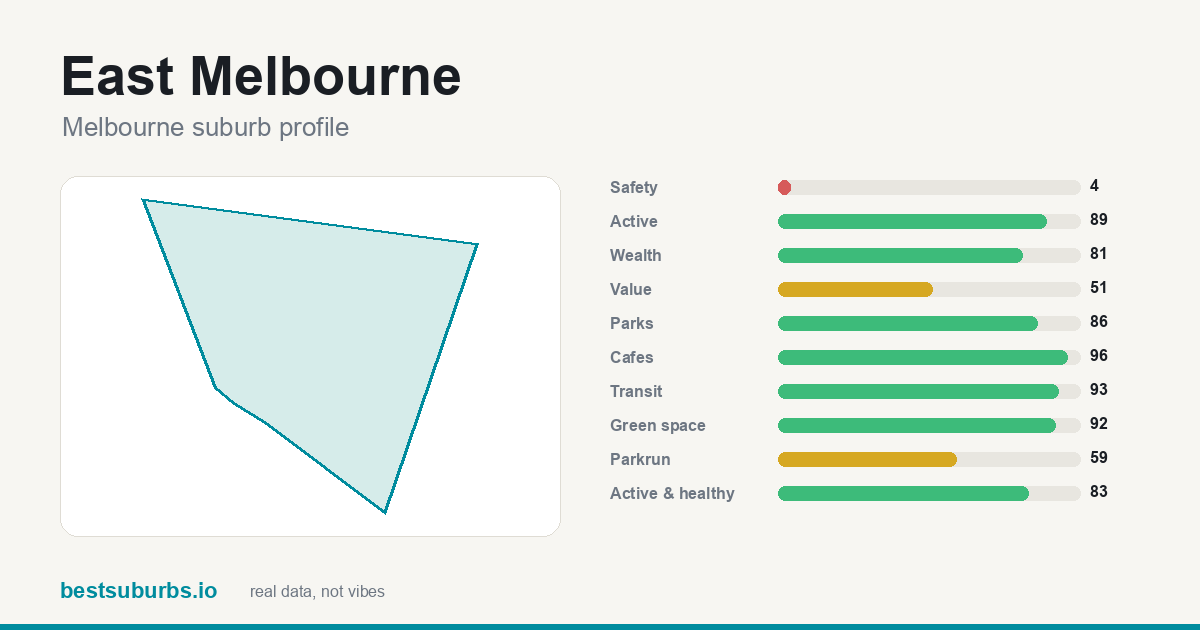
For the numbers we can measure, Melbourne is 216 very different suburbs rather than one answer: the median suburb rents at $408/wk (ABS Census 2021, whole-suburb medians); the median suburb's median house price is $1,295,500 (October–December 2025 quarter, 184 suburbs with 10+ sales); 45 of 216 suburbs score 80/100 or better on safety. Montmorency leads on safety, Eltham North leads on the families blend, Yallambie leads on value for money, East Melbourne leads on cafés, transit and street life, Parkville leads on green space, Fitzroy leads on public transport. What this guide cannot tell you: jobs, weather, or how a street feels — it ranks suburbs on official crime statistics, ABS census rent and income, sale prices where the state publishes them, and OpenStreetMap parks, cafés, transit and schools. Every ranking below links to its full list.
What salary do you need to live in Melbourne?
Using the common 30%-of-income housing-stress benchmark on ABS census rents: the median Melbourne suburb ($408/wk) needs a household income of roughly $71k a year; the cheapest quarter of suburbs ($381/wk or less) about $66k; the dearest quarter ($450/wk or more) about $78k or above. For comparison, the median Melbourne suburb's median household income in the 2021 census was $2,044/wk (about $106k a year). These are whole-suburb census medians across every dwelling size, so a one-bedroom flat sits well below and a family house well above — use them to rank suburbs, not to budget. Cheaper suburbs that still score at or above the city median for safety and public transport: Essendon ($380/wk), Ormond ($395/wk), South Morang ($390/wk), St Kilda East ($396/wk), Macleod ($396/wk) — see first home buyers in Melbourne and renting in Melbourne.
Where should I live when moving to Melbourne?
Pick by what you weight. Safety first: Montmorency, Eltham North, Gowanbrae (safest suburbs in Melbourne). Families: Eltham North, Montmorency, Macleod (best Melbourne suburbs for families). Value for money: Yallambie, Attwood, Diamond Creek (best value suburbs in Melbourne). Young professionals: East Melbourne, Hawthorn, Albert Park (cafés, transit and street life). Green space: Parkville, Essendon West, St Helena (greenest suburbs in Melbourne). Car-free living: Fitzroy, Melbourne, St Kilda (best public transport in Melbourne). Or set your own weights on the Melbourne suburb map and re-rank all 216 suburbs yourself.
Which Melbourne suburbs are the safest to move to?
On recorded criminal offences per 1,000 residents from the state's official crime statistics, the safest Melbourne suburbs are Montmorency (12.8 offences per 1,000 residents, safety 100/100), Eltham North (14.2 offences per 1,000 residents, safety 99/100), Gowanbrae (15.8 offences per 1,000 residents, safety 99/100), Briar Hill (16.1 offences per 1,000 residents, safety 98/100), Burnside Heights (17.1 offences per 1,000 residents, safety 98/100). The rate is per resident, so it measures recorded offences, not how a street feels. Full ranking of all 216 suburbs: safest suburbs in Melbourne.
Which Melbourne suburbs are best for families?
Blending safety, government-school proximity, parks, kindergartens, price-for-size and transit, the top family suburbs are Eltham North (families 86/100, nearest school 0.54 km, 5.66 ha of parks per 1,000 residents), Montmorency (families 84/100, nearest school 0.27 km, 2.48 ha of parks per 1,000 residents), Macleod (families 80/100, nearest school 0.57 km, 9.31 ha of parks per 1,000 residents), Diamond Creek (families 79/100, nearest school 1.22 km, 8.82 ha of parks per 1,000 residents), Briar Hill (families 78/100, nearest school 0.56 km, 0.43 ha of parks per 1,000 residents). School distance is straight-line from the suburb centre, not catchment zoning — check zoning with the school before you sign. Full list: best suburbs in Melbourne for families; the decision version is families moving to Melbourne.
How much does it cost to buy a house in Melbourne?
Across the 184 Melbourne suburbs with at least 10 house sales in the period, the median suburb's median house price is $1,295,500 (Victorian Property Sales Report, October–December 2025 quarter). Cheapest: Dallas ($640,000), Laverton ($640,000), Kings Park ($669,000), Broadmeadows ($670,000), Truganina ($672,000). Dearest: Toorak ($6,900,000), Brighton ($3,355,000), Hawthorn ($3,070,000), Canterbury ($3,000,000), Middle Park ($2,940,000). Medians move with what happened to sell in the period, so treat a single quarter as a guide; every suburb page shows the sale count behind its figure. Best offer-vs-rent trade-off: best value suburbs in Melbourne.
Which Melbourne suburbs will boom?
We do not forecast — nobody can from this data — but we can show what already moved. Over the past year, house medians rose in 148 of 184 Melbourne suburbs with 10+ sales, led by Carlton (+43.8%), Hughesdale (+36.6%), Middle Park (+26.0%), South Melbourne (+25.9%), Heidelberg Heights (+23.9%). Past growth is not a prediction, and a quarter's median swings with the mix of homes sold. Full ranking with sale counts: fastest-growing house prices in Melbourne.
Which Melbourne suburbs are close to the CBD and easy to commute from?
76 of the 216 scored suburbs sit within 10 km of the Melbourne CBD (straight-line from the city centre, not drive time) and 197 within 20 km. Of the inner ones, the best-served by public transport stops and stations (OpenStreetMap) are Fitzroy (2.1 km, transit 100/100), Melbourne (1.7 km, transit 99/100), St Kilda (5.9 km, transit 99/100), Southbank (1.4 km, transit 98/100), Windsor (5 km, transit 98/100). We do not hold timetable-based commute times; see each suburb page for its stop count and the public transport ranking.
Where do young professionals live in Melbourne?
On cafés per resident, public transport access and GPS-measured street activity, the suburbs that score highest are East Melbourne (96/100 cafés, 93/100 transit), Hawthorn (88/100 cafés, 89/100 transit), Albert Park (89/100 cafés, 87/100 transit), Melbourne (100/100 cafés, 99/100 transit), South Yarra (86/100 cafés, 91/100 transit). See best Melbourne suburbs for young professionals and best suburbs for coffee.
How do I compare two Melbourne suburbs before choosing?
Every suburb page has a compare link to its nearest neighbours, and any two to four suburbs can be compared side by side on all ten scores, rent and price. Popular pairs from the suburbs named above:
What else do people ask about moving to Melbourne?
How is this Melbourne relocation guide calculated?
From the same open data behind every page here — official crime statistics, ABS census income and rent, state sale-price data where it is published under an open licence, OpenStreetMap parks, cafés, transit and schools, and open GPS-activity traces — turned into per-suburb percentile scores. See how we rank suburbs.
How current is the data?
Rents and incomes are ABS Census 2021 medians; crime is the latest published year from the state agency; sale prices are October–December 2025 quarter; OpenStreetMap counts are refreshed each build. This page was rebuilt on 10 October 2026.
Can a suburb, agent or developer pay to appear here?
No. Nothing on this site is sponsored or paid placement, and no ranking can be bought. Guidance only — visit a suburb before you move there.
Computed from 216 scored Melbourne suburbs. Guidance only — visit a suburb before you move there. No suburb, agent or developer can pay for placement on this page or any ranking it links to. Sources and full method: how we rank suburbs.
Comparing Melbourne with another city?
What does it cost to live in Melbourne?
Cost of living in Melbourne: median rent $410/wk, household income $2,042/wk, cheapest and dearest suburbs.